

Safeguarding is a term which is broader than ‘child protection’ and relates to the action taken to promote the welfare of children and protect them from harm.
The Safeguarding Team
The Safeguarding Team can be contacted via the school office or school email address and are:
Miss D Stewart DSL – Assistant Headteacher
Mr P Stanley – Headteacher (Deputy DSL)
Mrs A Deakin – Deputy Headteacher (Deputy DSL)
Miss S Burness – Pastoral Lead (Deputy DSL)
**Please see below for our Child Protection Procedures**
Child Protection Procedures Poster
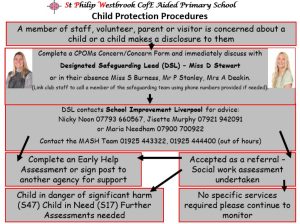
Safeguarding is everyone’s responsibility. Safeguarding is defined in Working Together to Safeguard Children 2026 as:
Safeguarding and promoting the welfare of children is defined for the purposes of this
guidance as:
• providing help and support to meet the needs of children as soon as problems
emerge
• protecting children from maltreatment, whether that is within or outside the
home, including online
• preventing impairment of children’s mental and physical health or development
• ensuring that children grow up in circumstances consistent with the provision of
safe and effective care
• promoting the upbringing of children with their birth parents, or otherwise their
family network4 through a kinship care arrangement, whenever possible and
where this is in the best interests of the children
• taking action to enable all children to have the best outcomes in line with the
outcomes set out in the Children’s Social Care National Framework
In school we safeguard children in many ways, details of which can be found below. All staff receive annual safeguarding training to ensure that it remains our highest priority.
Our school is also part of a project called Operation Encompass which is run between the local authority and police. The project has been designed to provide early reporting of domestic violence incidents that occur outside school which might have an impact in school. All staff are also trained in the Prevent strategy, the purpose of Prevent is to stop people from becoming terrorists or supporting terrorism. This includes countering terrorist ideology and supporting individuals who are especially vulnerable to becoming radicalised.
Family Help
We also offer Family Help support – see our Mental Health and Wellbeing page for more information and the brochure below. Early help refers to the offer of any information, advice or support to children, young people and their families as soon as possible in their lives, or when issues emerge, to help prevent problems from escalating.
Operation Encompass
Our school participates in a Police led initiative called Operation Encompass. This is a partnership between Cheshire schools and the Police, which helps schools to better support any child where a domestic incident has been reported to Police from their home.
Following a domestic incident, the Police will make contact with the child’s school via telephone and secure email (usually the next day) to communicate relevant information to a nominated member of school staff. This will ensure that as a school, we are made aware early enough, to support children and young people in a way that means they feel safe, supported and listened to. It will also provide an opportunity for school to offer support to the whole family.
The initiative was launched county-wide at the beginning of 2016. It is active in all Cheshire schools. You can find out more about Operation Encompass via the following site: http://www.operationencompass.org.


Warrington Safeguarding Partnerships
The Child and Social Work Act 2017 requires the Local Authority, the Integrated Care Board (ICB) and the police to make arrangements to work together to safeguard and promote the welfare of children.
The partnership does not commission or deliver direct frontline services. Our job is to make sure that the services that partners deliver or commission all work well together and that they are effective in keeping children and young people safe.
Our aims are that:
- Every child and young person in Warrington is safe and healthy and has the opportunity to reach their potential.
- We create a ‘challenge and check’ process for practice; and
- We embed a culture of learning that always seeks to make improvements.
Our core partners are Warrington Borough Council, NHS Cheshire & Merseyside ICB, Cheshire Constabulary (Police) and School Improvement Liverpool Safeguarding Advisory Service.


The Partnership is responsible for monitoring the performance of local agencies’ arrangements for safeguarding children as set out in section 11 of the Children Act 2004.
The partnership will consult with community groups so that the needs of community are being met. The voice of the child and families are central to the work of Warrington Safeguarding Partnership (WSP).
We will also link to working groups across Cheshire, such as the Pan Cheshire Child Death Overview Panel (CDOP) to ensure we work collaboratively to improve children’s experiences.

Further information about our safeguarding arrangements is available in the Warrington Safeguarding Partnership Annual Report document.
Click this photo for more information 
Children Missing from Education Policy
Child Protection and Safeguarding Policy
Warrington Family Help Brochure
Keeping Children Safe in Education 2026
Managing Allegations Against Staff and Volunteers
Preventing Extremism and Radicalisation
Web filtering and monitoring
The designated safeguarding lead (DSL) has lead responsibility for filtering and
monitoring and works closely with our Trust Chief Operating Officer and Techminder,
our IT support provider, to implement the DfE filtering and monitoring standards, which
require schools to:
• identify and assign roles and responsibilities to manage filtering and monitoring
systems.
• review filtering and monitoring provision at least annually.
• block harmful and inappropriate content without unreasonably impacting
teaching and learning.
• have effective monitoring strategies in place that meet their safeguarding needs.
We look to provide ‘appropriate filtering and monitoring (as outlined in Keeping Children
Safe in Education) at all times.
We ensure ALL STAFF are aware of filtering and monitoring systems and play their part
in feeding back about areas of concern, potential for pupils to bypass systems and any
potential overblocking. They can submit concerns at any point via e-mail and will be
asked for feedback at the time of the regular checks which will now take place.
Technical and safeguarding colleagues work together closely to carry out annual reviews
and check and also to ensure that the school responds to issues and integrates with the
curriculum.
We carry out checks to ensure all systems are in operation, functioning as expected,
etc and an annual review as part of an online safety audit of strategy, approach etc.
More details of both documents and results are available on request dependent on staff
roles.
At our school we recognise that generative AI sites can pose data risks so staff are not
allowed to enter child data and where they use them, they must be approved. For
children and young people, we block the generative AI category and only allow specific
sites. We know that what children input and what the tool outputs cannot be guaranteed
as safe and inappropriate content can be generated, so we carefully monitor output and
limit their use – also in line with DfE guidelines. Find out more at genaisafe.lgfl.net
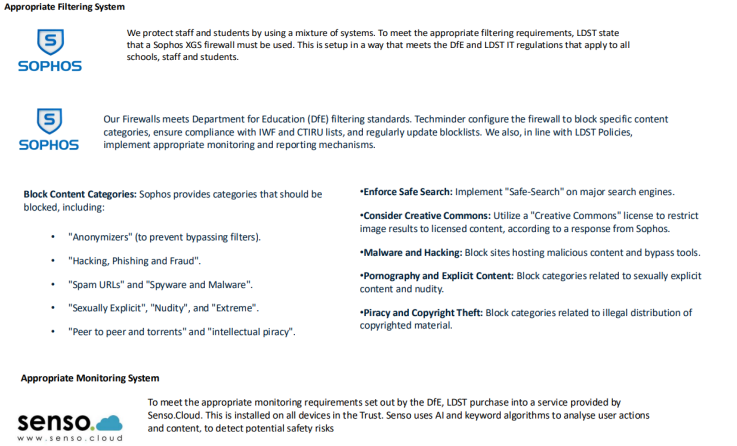
Safe Search is enforced on any accessible search engines on all school-managed
devices.
We recommend the use of searching through the SENSO App and block all others.
Our YouTube mode is set to strict.
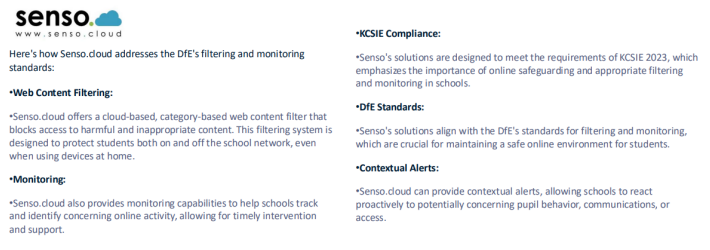
Out of hours, we use Senso.cloud and the violations are sent in real time. All devices
offsite will be monitored but not filtered. When pupil devices are offsite we enable
senso.cloud’s web filtering policy.
Staff will be reminded of the systems in place and their responsibilities at induction and
start of year safeguarding as well as via AUPs and regular training reminders in the light
of the annual review and regular checks that will be carried out.
The DSL checks filtering reports and notifications and takes any necessary action as a
result.
According to the DfE standards, “Your monitoring plan should include how you will
monitor students when using school-managed devices connected to the internet. This
could include:
• device monitoring using device management software
• in-person monitoring in the classroom
• network monitoring using log files of internet traffic and web access”
Staff Responsibilities include:
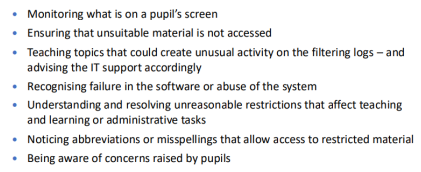
How we protect staff and pupils – filtering and monitoring
| Useful Information Sources | |
| BBG Guidance | BBC Guidance – BBC Guidance Advice for Parents when Sharing Photos of Your Child |
| CEOP | Child Exploitation and Online Protection Centre (CEOP) – their main site for advice, help and to report an issue |
| Thinkuknow | Parents & Carers – The CEOP’s ThinkUKnow guidance and awareness information for parents and carers. |
| Anti-Bullying Alliance | Anti-Bullying Alliance – this is an alliance of over 60 organisations, who work together to stop bullying and create safer environments for children and young people. |
| Digizen | The Digizen website provides information for educators, parents, carers, and young people. It is used to strengthen awareness and understanding of digital citizenship. |
| Child Net | e-Safety tips, advice and resources to help children and young people stay safe on the internet. |
| UKCIS | The UK Council for Child Internet Safety (UKCIS) is a group of more than 200 organisations drawn from across government, industry, law, academia and charity sectors that work in partnership to help keep children safe online. |
| Google Safety | The web was designed to be explored, but Google has controls to help you keep it a safer place for your family to roam. Visit their facilities to learn about the online tools available. |
| Get Safe Online | Get Safe Online is one of the UK’s leading source of unbiased, factual and easy-to-understand information on online safety. |